
Your Next Dollar of Margin is Hiding in Your Timesheets
How Leading Staffing Firms Reduce Revenue Leakage Before It Reaches the P&L

A wrong overtime rate. A missed shift differential. A few hours entered late.
On their own, these errors seem insignificant, which is exactly why they go unnoticed. But multiplied across hundreds or thousands of workers, they become a silent drain on profitability. For staffing firms operating on average net margins of just 3.3%, revenue leakage from time and billing errors can quietly erase more than an entire year's profit.
The challenge isn't a lack of diligence. Most staffing firms have experienced operations, payroll, and finance teams. The problem is that modern staffing organizations process time across multiple systems, contracts, approval workflows, and overtime rules which creates complexity that manual review cannot consistently overcome.
In this article, you'll learn:
Why time is one of the most difficult data points in staffing to manage accurately
The three most common sources of staffing revenue leakage hidden inside timesheets
What leading staffing firms are doing to improve time reconciliation
Why Time Is the Hardest Number in Staffing to Get Right
In most businesses, hours worked are recorded once. In staffing, the same hours are captured in multiple places at once - a VMS portal, an internal time system, and a client's own records - and they rarely agree.
Each system structures time differently, with its own field names, shift codes, approvals, and overtime rules. Reconciling those differences across thousands of time clocks often requires extensive manual review.
Multiply that across every pay cycle and even a well-staffed operations team can spend days verifying records. The bottleneck is fragmented data and complexity that manual processes struggle to keep pace with.
The 3 Biggest Sources of Time Revenue Leakage
Most revenue leakage can be traced back to three common patterns:
1. Overtime Miscalculations
Overtime in staffing is governed by multiple overlapping rule sets, including federal regulations, state laws, client contracts, and engagement-specific agreements. Applying the wrong rule or multiplier is one of the most common payroll and billing errors.
2. Late and Missing Timesheets
Hours not captured on time are hours that may never be billed at all. Late submissions remain one of the most persistent sources of staffing revenue leakage. This is revenue that was earned but never collected.
3. Multi-System Mismatches
When the same hours exist across a VMS, ATS, client HRIS, payroll platform, or mobile time-tracking tool, small discrepancies in hours, rates, and approvals compound with every handoff. Without a single source of truth, those mismatches multiply quietly over time.
How Much Do Timesheet Errors Really Cost?
The most expensive feature of a timesheet error is time itself.
A discrepancy caught before payroll runs may take minutes to fix. The same issue discovered months later, often during a client audit, can result in credits, rebilling, delayed collections, and damaged trust. The drag is measurable. Every extra day spent reconciling delays billing and cash collection, directly inflating days sales outstanding (DSO). Billing errors alone can add 10–15 days to DSO.
What Effective Time Reconciliation Looks Like
If time errors can quietly erase profit, inflate DSO, and create compliance risk, the question becomes: how do leading staffing firms prevent them?
The answer isn't more spreadsheets or larger verification teams. It's building a reconciliation process that validates time accurately, consistently, and at scale before errors reach payroll and billing.
Comprehensive Time Validation: Automatically verifies every timesheet against assignment details, pay and bill rates, overtime rules, shift differentials, contract terms, approvals, and client-specific requirements before payroll and billing.
Cross-System Reconciliation: Compares and reconciles time data across VMS platforms, ATS systems, payroll applications, client HRIS platforms, and other time-tracking tools to identify discrepancies before they create downstream issues.
Exception-Based Workflows: Surfaces only records that contain discrepancies or require review, allowing teams to focus on resolving high-impact exceptions instead of manually auditing every timesheet.
Auditability and Compliance Controls: Maintains a complete, traceable record of validations, exceptions, and resolutions to support regulatory compliance, client audits, and internal financial controls.
When organizations establish a trusted source of truth for time, the benefits extend beyond payroll accuracy. Strong reconciliation helps recover revenue, reduce DSO, improve operational efficiency, strengthen compliance, and protect margins before errors reach payroll and billing.
How Hercules Handles Time Reconciliation From Policy Ingestion to Validated Time
Hercules verifies submitted hours against extracted policy rules, flagging discrepancies before payroll runs and billing are sent.
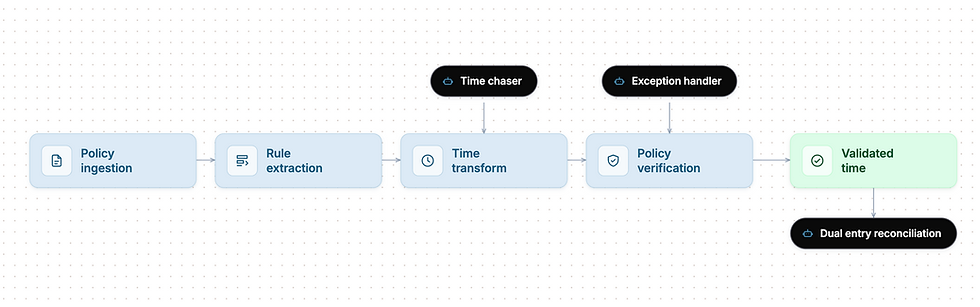
Step | Description |
Policy ingestion | Pulls in contracts, statements of work, and policy documents via API or manual upload. Outputs a clean, versioned set of source documents for downstream rule extraction. |
Rule extraction | Reads ingested contracts, SOWs, and policy documents to extract every rule that downstream checks rely on. Builds a structured rule library scoped to each client, project, and worker class. |
Time transform | Maps VMS and time entry system data into a single source-of-truth schema. Resolves field-name, time-zone, rounding, and pay-code differences so records are consistent before validation. |
Policy verification | Validates every record against the rule library and cross-checks sources against each other. Items with a one-click suggested fix are routed for quick analyst approval; everything else branches to the exception queue. |
Validated time | Clean, verified time records — every hour accounted for, every rule passed. Ready to hand off to final reconciliation for payroll and billing. |
Agent | Description |
Time chaser Agent | Polls every system that records hours for the open pay period — VMS, time entry system, external clocks — and chases anyone who hasn't submitted. Lands a complete, deadline-ready roster before payroll and billing runs. |
Exception handler Agent | Surfaces every flagged item to an analyst with both source records side-by-side and the violated rule highlighted. The analyst picks a resolution; the agent logs an audit note and pushes the resolved record forward. |
Dual entry reconciliation Agent | Produces the definitive record for the period — what each system held, what changed, and who approved it. Output is audit-ready for payroll and billing. |
The Bottom Line
When that time is inaccurate, delayed, or inconsistent across systems, the effects ripple through payroll, billing, collections, and profitability. The challenge is that most discrepancies are too small to trigger concern individually, which is exactly why they persist.
In a market where average net margins hover around 3.3%, time reconciliation is financial control that protects revenue, accelerates cash flow, and reduces operational risk.
The firms that outperform won't simply generate more demand. They'll capture, validate, and bill every hour they've already earned.
Your next dollar of margin is likely hiding in your timesheets.
See how Hercules Time Reconciliation helps staffing firms uncover revenue leakage, reduce DSO, and protect profitability before errors reach payroll and billing. Learn more.


